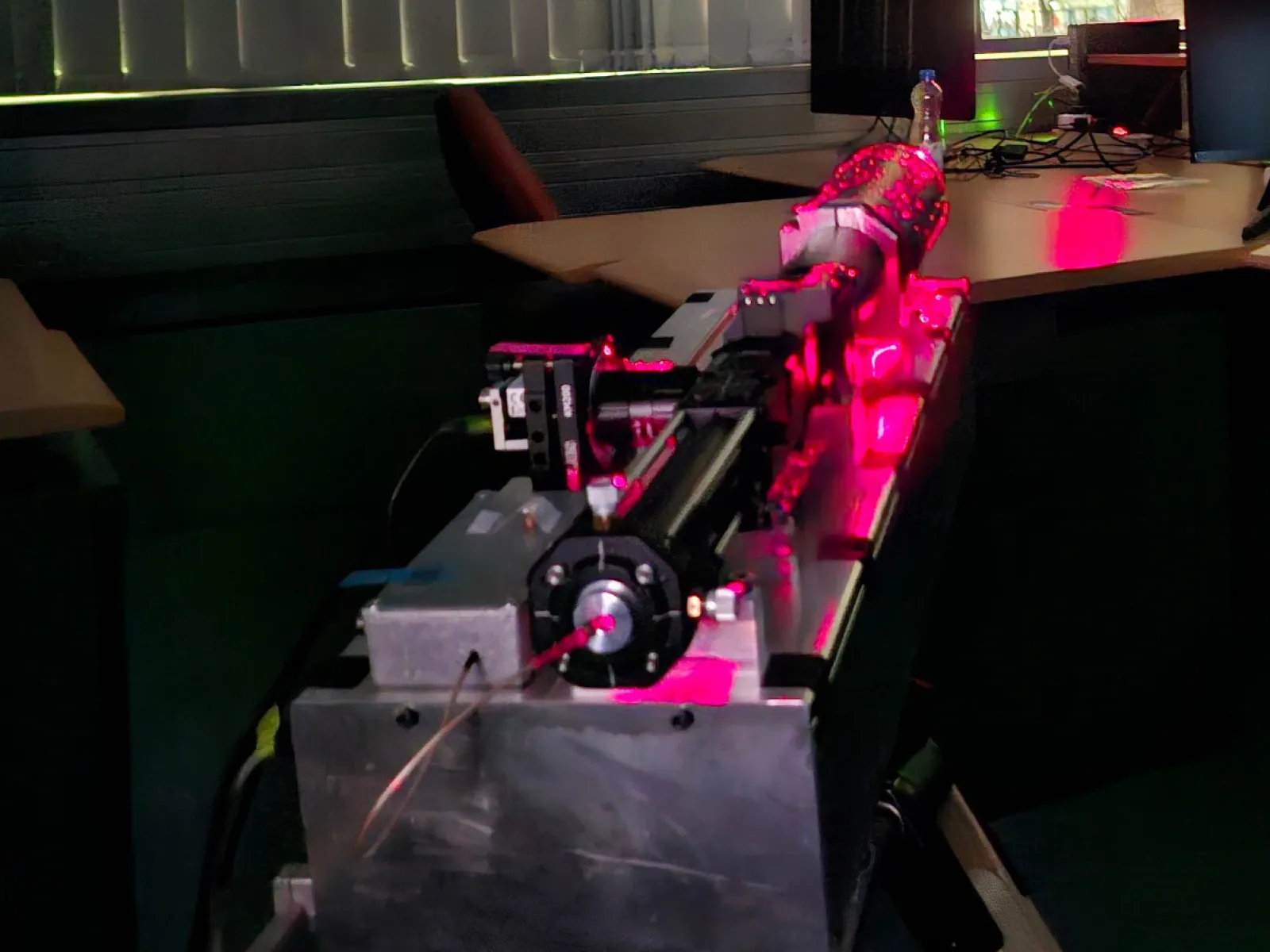
Researchers from the Budapest University of Technology and Economics (BME) Faculty of Electrical Engineering and Informatics successfully transmitted entangled photon pairs over a free-space channel spanning half a kilometer.
The experiment was conducted during the night of February 21–22, 2026, between the Schönherz Dormitory and the BME Building I. The researchers verified the presence of entanglement using a Bell test, which demonstrates that such a high level of correlation between two distant points cannot be explained by classical physics based on local hidden variables.
The degree of nonlocality can be quantified using the CHSH inequality through the so-called |S| parameter. Any value greater than 2 clearly indicates quantum behavior. In the experiment, the researchers achieved a CHSH inequality violation of |S| > 2.6, which is considered a strong result even under laboratory conditions.
The development of the free-space quantum communication system involved researchers from the Department of Network Systems and Services at BME, as well as the Department of Atomic Physics of the Faculty of Natural Sciences. The successful experiment confirms the proper operation of the Hungarian-developed optical, electronic, and software components of the system. The research was supported by the Quantum Information National Laboratory of Hungary.